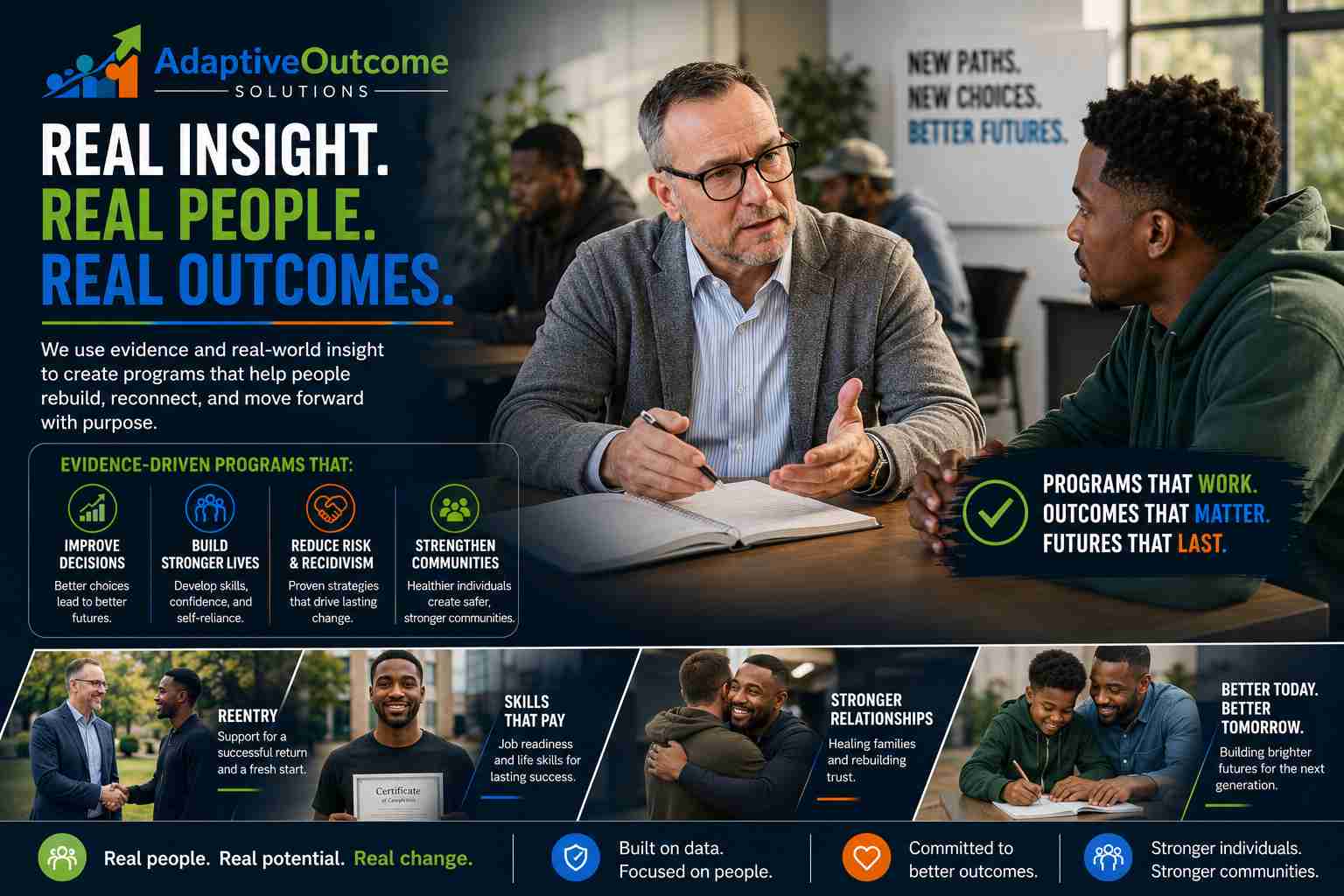
Evidence-informed development built from real participant information.
Adaptive Outcome Solutions uses structured participant information, behavioral pattern analysis, practitioner review, intervention responses, and outcome tracking to build a clearer picture of the factors influencing participant progress over time.
Why we describe AOS as evidence-informed.
AOS is built from real participant responses, descriptive data, recurring behavioral patterns, practitioner experience, and ongoing review. The system is designed to improve the information available for case planning without replacing professional judgment or claiming more certainty than the evidence supports.
Real Participant Information
The research base comes from structured participant information rather than invented profiles, generic assumptions, or purely theoretical case examples.
Pattern-Focused
AOS examines recurring relationships among behavior, pressure, regulation, accountability, stability, decision-making, and real-world outcomes.
Designed to Keep Learning
New behavioral evidence can be compared with earlier findings so the system can be refined, challenged, strengthened, or corrected as the evidence grows.
AOS is designed to support—not replace—professional judgment. Findings should be interpreted alongside practitioner experience, direct observation, participant history, collateral information, and other appropriate assessment information.
Evidence should grow with the participant.
The long-term AOS model connects multiple sources of behavioral evidence instead of treating one assessment as the entire picture.
Baseline
Structured intake establishes a starting behavioral picture based on participant history, current circumstances, pressures, strengths, and needs.
Identify
Related information is organized into recurring patterns, inconsistencies, strengths, barriers, and case-planning priorities.
Intervene
Findings can be connected to structured workbooks, services, coaching, referrals, programming, and practitioner-guided case planning.
Measure
Workbook responses, weekly behavior, practitioner observations, engagement, services, and outcomes can add evidence over time.
Report
Participant-level evidence can become practitioner intelligence and aggregate program intelligence for evaluation and reporting.
Evidence & research library.
These visual summaries explain the behavioral patterns, research findings, and working models that have emerged from the current AOS research base. Click any card to open the full 8.5×11 infographic.
Master Behavioral Research Index.
The Master Behavioral Research Index consolidates the current participant database, verified counts, recurring behavioral clusters, research findings, emerging hypotheses, limitations, and future validation priorities.
Evidence should improve the next decision.
AOS is being developed to connect participant information, behavioral intelligence, targeted intervention, ongoing measurement, and program reporting in one practical system for organizations responsible for real-world outcomes.